
Alameda County Court are available to the public through official court-controlled systems that allow people to review case activity and request copies. These records cover civil, criminal, family, probate, and traffic matters and reflect actions taken by the court during each stage of a case. Many records appear online for public viewing, which helps users confirm filings, hearing dates, and case status. Some documents remain restricted based on California law and court rules. This structure supports lawful public review of judicial records.
Alameda County Court are maintained by the Alameda County Superior Court, not by county administrative offices. The Superior Court manages filings, case updates, and document storage under state judicial standards. Online tools display eligible public court records, while older files or certified copies may require an in-person or written request. This process sets clear expectations for digital versus courthouse-based services. County legal records follow strict compliance rules to protect privacy and accuracy.
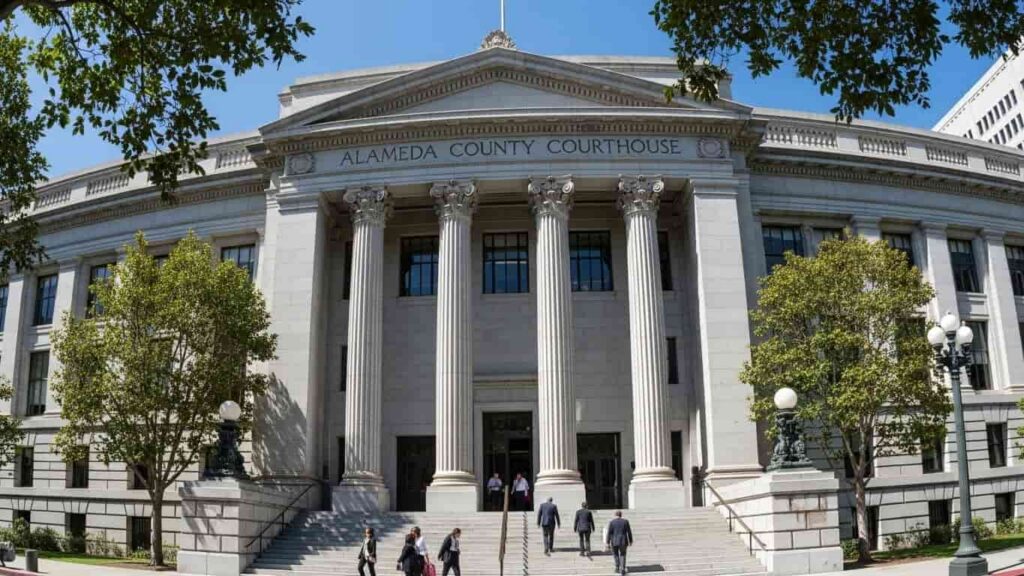
What Are Alameda County Court Records?
Alameda County court records are official files created during legal cases handled within the county’s trial courts. These records document case progress, filings, parties, and final rulings in a clear written format. They serve as a factual history of legal actions and outcomes recorded by the court system. People often review them for legal research, background checks, or case follow-up.
Case Information vs. Full Court Documents
Court records fall into two main categories: case information and full court documents. Each serves a different purpose.
Case information often includes:
- Case number and filing date
- Names of parties involved
- Case type and current status
- Scheduled hearings or rulings
Full court documents include:
- Legal filings submitted by parties
- Motions, responses, and court orders
- Judgments, verdicts, or dismissals
Types of Data Found in Judicial Case Records
Alameda County court records contain several data points that help clarify what happened during a case. These judicial case records typically include:
- Party details such as plaintiffs, defendants, or attorneys
- Legal filings like complaints, petitions, and motions
- Court actions including hearings, rulings, and continuances
- Judgments and outcomes that show final decisions
How to Search Alameda County Court Records Online
The official Alameda County court records search is available on the county court website and allows users to look up cases by name or case number. The system displays case summaries, filing history, and current status in a structured format.
Official website URL: https://www.alameda.courts.ca.gov
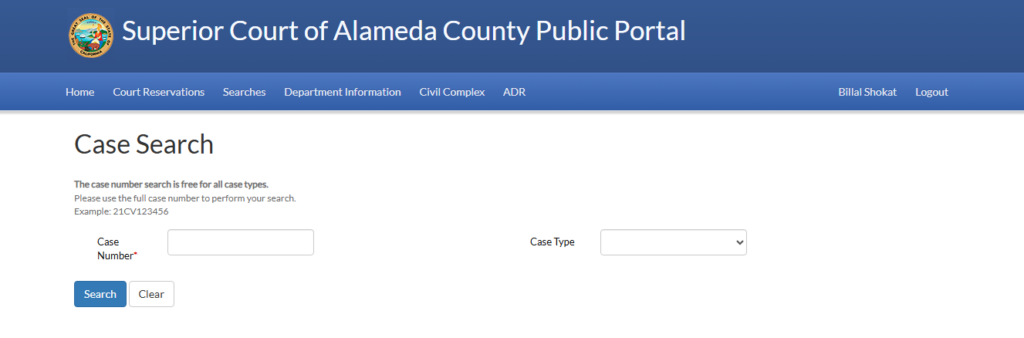
Open the Search Page
Visit the official website listed above. Locate the online case search section. This page contains the main search form used for all lookups.
Choose a Search Method
Users may search using one of the following inputs:
- Case Number – best for direct results
- Party Name – useful when the case number is unknown
- Court Type – helps narrow civil, criminal, family, or probate cases
Enter Case Number
Type the full case number exactly as shown on court paperwork. Include all numbers, letters, and symbols. One missing character may prevent results from loading.
This method usually returns:
- A single case match
- Complete case summary
- Full docket list
Enter Party Name (If Case Number Is Unknown)
Use the full legal name of one party. Enter the last name first if the form allows. Avoid abbreviations or shortened names.
If many results appear, narrow them by:
- Court type
- Filing year
- Case category
Select Court Type
Court type filters help refine results. Options often include:
- Civil
- Criminal
- Family
- Probate
- Traffic
Run the Search
Submit the form after reviewing all entries. The system then displays matching court case files.
Types of Court Records Available in Alameda County
Alameda County maintains a wide range of legal court records that document case activity across several court divisions. These court documents cover civil disputes, criminal matters, family issues, estate cases, and limited-jurisdiction filings like traffic and small claims. Court records in Alameda County reflect filings, rulings, and case progress created by the Superior Court. Each record type serves a different legal purpose, so knowing the category saves time and sets clear expectations.
Civil Court Records
Civil case records relate to disputes between parties rather than criminal charges. These legal court records often involve money, property, or contract issues.
Common civil court documents include:
- Complaints and responses
- Motions and court orders
- Judgments and settlement filings
Civil case records frequently cover personal injury claims, breach of contract disputes, landlord–tenant cases, and debt matters. Many filings show timelines, hearing dates, and final outcomes, which helps confirm case status.
Criminal Court Records
Criminal case files document matters where the state brings charges against a defendant. These court documents track the full case path from arrest through resolution.
Typical criminal records contain:
- Charging documents and case numbers
- Bail and custody information
- Plea entries, trial results, and sentencing
Criminal case files may involve misdemeanors, felonies, or infractions. Each record reflects actions taken by the court, prosecutors, and defense counsel.
Family & Divorce Records
Family court documents address legal issues involving household relationships. These records focus on personal status and long-term responsibilities.
Examples include:
- Divorce and legal separation filings
- Child custody and visitation orders
- Child or spousal support rulings
Probate & Estate Records
Probate records relate to asset distribution and care decisions after death or incapacity. These legal court records guide estate administration.
Probate court documents often cover:
- Wills and estate petitions
- Executor or administrator appointments
- Guardianship and conservatorship cases
Small Claims & Traffic Cases
Limited-jurisdiction filings handle lower-value disputes and traffic enforcement matters. These court documents follow simplified procedures.
Key record types include:
- Small claims cases involving capped dollar amounts
- Traffic citations and infraction rulings
- Payment plans and compliance orders
Alameda Superior Court Records
Alameda Superior Court records form the main source of trial court documents for cases filed within the county. These records reflect how civil and criminal matters move from filing to final ruling under state trial court authority. The Superior Court of California, County of Alameda serves as the primary trial court for local legal disputes. As a result, most official case activity appears first in this court’s system.
Role of Alameda Superior Court
The Alameda Superior Court operates as the county’s trial-level court under California law. It handles hearings, trials, and judgments rather than appeals. Judges here review evidence, rule on motions, and issue binding decisions. This court produces a wide range of trial court documents, such as filings, minute orders, and judgments. Each record reflects real-time court activity and procedural steps. So, researchers and parties often begin a superior court case search here.
Case Types Handled by the Court
Alameda Superior Court records span several legal areas. These case categories cover both high-volume filings and complex disputes.
Civil and criminal court records often include:
- Contract disputes, property claims, and injury lawsuits
- Misdemeanor and felony prosecutions
- Pretrial motions, trial outcomes, and sentencing orders
Family law records focus on household-related legal matters. These filings often involve:
- Divorce and legal separation cases
- Child custody, visitation, and support rulings
- Domestic violence restraining orders
Why Most Records Originate Here
Nearly all local cases begin at the superior court level. Appeals courts review decisions later, yet they rely on trial records created here. That makes Alameda Superior Court records the foundation for the county’s legal history. A superior court case search often reveals the full case timeline, from initial filing through final disposition. These trial court documents show how judges apply state law in real disputes. So, civil and criminal court records stored here carry long-term legal value.
Requesting Court Records in Alameda County
A record request in Alameda County can be submitted online, by mail, or through the clerk’s office in person. Each court documents request follows a set process that depends on record type, format, and delivery method. Court records are maintained by the Alameda County Superior Court Clerk. The clerk reviews every public records request and releases eligible documents based on court rules and state law.
Online Requests
Online submissions offer a convenient starting point for document retrieval. Many non-certified filings can be requested through the court’s electronic services.
Online requests often work best for:
- Recent civil and criminal filings
- Case dockets and minute orders
- Non-confidential trial court documents
Mail-In Requests
Mail-in requests suit those seeking certified copies or older files. This records request process requires a written form or letter with clear case details.
A complete mail request usually includes:
- Case name and case number
- List of requested court documents
- Return mailing address and contact details
- Payment by check or money order
In-Person Clerk Requests
In-person clerk office requests allow direct interaction with court staff. Many visitors choose this option for urgent needs or complex searches.
At the courthouse counter, staff can help with:
- Locating case files by index
- Submitting a public records request
- Explaining copy fees and certification options
Processing Timelines
Processing times depend on record age, format, and workload. Simple document retrieval may take a few business days. Certified copies or archived files often require more time.
Typical timelines include:
- Online requests: 1–5 business days
- Mail-in requests: 5–15 business days
- Archived or off-site records: longer review periods
How to Obtain Certified Copies of Court Records
Certified copies are official court documents issued with a court seal and clerk verification. These stamped legal records confirm authenticity for legal, financial, and government use. Courts issue certified court documents to prove that a copy matches the original record on file. Alameda County provides this service through the Superior Court Clerk.
When Certified Copies Are Required
Certified copies serve formal purposes where proof matters. Many agencies refuse plain copies for legal actions.
Common situations that require certified copies include:
- Filing appeals or post-judgment motions
- Submitting evidence to government agencies
- Recording property or probate-related documents
- Verifying divorce decrees or name changes
Banks, employers, and licensing boards often request authentication of records. A court seal and clerk signature confirm that the document holds legal weight.
Difference Between Plain and Certified Copies
Plain copies reproduce court filings without official verification. They work well for personal review or informal reference.
Certified copies differ in several key ways:
- Include a raised or stamped court seal
- Carry a clerk’s certification statement
- Meet legal standards for official use
Official court copies confirm accuracy and origin. Plain copies do not provide that assurance. The intended use determines which format fits best.
Request Process
Certified copies can be requested online, by mail, or at the clerk’s office. Not every document qualifies for online certification, so availability may vary.
A typical request requires:
- Case name and case number
- Document title and filing date
- Requestor contact details
- Payment for copy and certification fees
Fees and Turnaround Time
Fees depend on page count and certification type. Courts usually charge a per-page copy fee plus a flat certification cost.
Typical timelines include:
- Counter requests: same day or next business day
- Mail requests: several business days after receipt
- Archived records: extended processing time
Fees, Processing Time & Access Restrictions
Court records in Alameda County follow set rules for availability, pricing, and review timelines. Fees and release limits depend on document type, format, and privacy status. The Superior Court manages how records are released to the public. Some files are open for review, and others carry legal limits that affect availability.
Fee Ranges for Court Records
Copy costs vary by format and certification level. Courts publish general ranges rather than fixed prices, since page counts and services differ.
Typical fee ranges include:
- Plain copies: low per-page cost
- Certified court documents: per-page fee plus a certification charge
- Archived files: higher retrieval costs
Processing Time Expectations
Processing time depends on request volume and record location. Recent electronic files move faster than older paper records.
General timelines include:
- Standard copy requests: a few business days
- Certified or mailed orders: up to two weeks
- Off-site or archived files: longer review periods
Public vs Confidential Court Records
Many filings qualify as public records. Others fall under confidential court records rules set by state law and court policy.
Restricted files often involve:
- Juvenile matters
- Adoption and guardianship cases
- Mental health proceedings
Redacted Information Rules
Some public records contain redactions. Courts remove sensitive data before release to protect privacy.
Common redactions include:
- Social Security and bank numbers
- Home addresses in protected cases
- Names of minors
Alameda County Court Clerk’s Role in Records Availability
The Alameda County court clerk serves as the official custodian of court files and case materials. This office manages how Alameda County court records are filed, stored, and released under court authority. The clerk’s office functions as the operational center for record handling across court divisions. Every filing, order, and judgment passes through this office as part of judicial administration.
Court Clerk Office as Records Custodian
The court clerk office holds responsibility for maintaining the official case file. That role includes indexing documents, preserving originals, and tracking case activity.
As records custodian, the clerk:
- Receives and processes court filings
- Maintains electronic and paper case files
- Issues copies and certified documents
- Applies privacy and sealing rules
Filing Office Within Judicial Administration
The clerk operates within the court’s judicial administration framework. Judges issue rulings, and the clerk records those actions into the official docket.
Key duties tied to judicial administration include:
- Recording court minutes and judgments
- Managing hearing calendars
- Updating case status after rulings
Who Maintains Court Records
No single judge or department holds exclusive control over records. The clerk office manages files on behalf of the court as a whole.
That responsibility means:
- Judges decide what may be sealed or released
- Clerks carry out those orders
- Staff follow state and local court rules
Locations & Office Addresses
Alameda County Superior Court operates multiple courthouses throughout the county that serve different divisions and public services. These Alameda Superior Court locations help people file cases, pick up certified copies, and access records in person.
Main Alameda Superior Court Locations
Here are the key courthouse locations where you can access public records and clerk services:
René C. Davidson Alameda County Courthouse
1225 Fallon St, Oakland, CA 94612
Phone: 510-891-6000 (main)
Clerk services here support general filings, scheduling, and records inquiries. Oakland locations are central for civil and criminal matters.
Alameda County Superior Court Berkeley Courthouse
2120 Martin Luther King Jr Way, Berkeley, CA 94704
Phone: 510-647-4439
Primarily handles probate matters. Probate filings and examiner services are available during weekday clerk hours.
Alameda County Superior Court (Alameda)
2233 Shoreline Dr, Alameda, CA 94501
Phone: 510-891-6005
Includes records management and settlement units. Suitable for reviewing older files and obtaining copies.
Superior Court of California (East County Hall of Justice)
5151 Gleason Dr, Dublin, CA 94568
Phone: 925-227-6700
Focuses on criminal and traffic cases with full clerk services.
Wiley W. Manuel Courthouse
661 Washington St, Oakland, CA 94607
Phone: 510-627-4700
Handles criminal and traffic matters; jury services also located here.
Hayward Hall of Justice
24405 Amador St, Hayward, CA 94544
Phone: 510-690-2700
Covers civil and family law filings, with self-help and ADR services.
Alameda County Superior Court (San Leandro)
2060 Fairmont Dr, San Leandro, CA 94578
Phone: 510-891-6332
Provides mental health and related services; often specialized.
Frequently Asked Questions
Alameda County court records include filings and case activity created by the Superior Court. Many of these records are open to the public, with limits set by law for privacy and court control.
Are Alameda County court records public?
Many Alameda County court records qualify as public records. Civil and criminal filings, dockets, and judgments are often available for review. Some court documents remain restricted due to privacy rules, case type, or court orders. Juvenile cases, certain family matters, and sealed filings do not appear in public searches.
How does someone find Alameda Superior Court records online?
Alameda Superior Court records may be located through the court’s official online case system. A superior court case search typically uses a case number or party name. Online systems usually display case summaries, hearing dates, and selected trial court documents. Full file access may still require clerk review or an in-person visit.
Can certified copies be requested remotely?
Certified copies can often be requested without visiting a courthouse. Many court documents requests are accepted online or by mail, depending on document type. Certified court documents that require clerk verification may involve longer processing. Some older files or sealed records require additional review before release.
How long does a record request take to process?
Processing time varies based on record age, format, and request volume. Recent electronic files may be processed within a few business days. Mail-in requests and certified copies usually take longer. Requests involving archived or off-site storage often extend the timeline. Payment confirmation and clerk review occur before release.
Why are some court documents unavailable?
Some court documents remain unavailable due to access limitations set by law. Confidential court records protect privacy in sensitive matters. Sealed case files require a judge’s order before release. In other situations, records may appear unavailable because they predate digital systems or remain under active review.
Which office maintains court records in Alameda County?
The Superior Court Clerk serves as the records custodian. This filing office maintains court files, applies redaction rules, and issues official court copies. Judges determine access limits, and clerks carry out those orders under judicial administration rules.
Does court location affect record availability?
Yes. In-person records access depends on courthouse location and case assignment. Some older or archived files are stored at specific superior court branches. Certified copy pickup and file review often require visiting the correct clerk office location.