
Alameda County Superior Court is the primary trial court serving Alameda County, California. It operates as part of the Superior Court of California and handles a wide range of legal matters under state law. The court plays a central role in resolving disputes, reviewing evidence, and issuing legal decisions that affect daily life across the county. It follows procedures set by the California judicial system and applies state statutes consistently. Residents, legal professionals, and researchers rely on this court for accurate and timely case handling.
Alameda County Superior Court holds jurisdiction over civil, criminal, family, and probate cases filed within county boundaries. Civil matters may include contract disputes or property issues, and criminal cases cover both misdemeanors and felonies. Family law cases address divorce, child custody, and support, and probate cases focus on estates and guardianships. The court operates through multiple courthouse locations to serve different communities. Its work reflects how California trial courts function at the local level and why this court matters to the county’s legal system.
How to Search Alameda County Superior Court Cases Online
Alameda County Superior Court case search is completed through the court’s official online portal, which allows searches by name or case number. The system displays public case details, hearing dates, and filing history in real time. Users can search court records by entering basic case details, selecting a case type, and reviewing the results list generated by the court database.
Official Alameda County Superior Court Case Search Website
The official online case search system is hosted directly by the court.
Official Site URL: https://eportal.alameda.courts.ca.gov
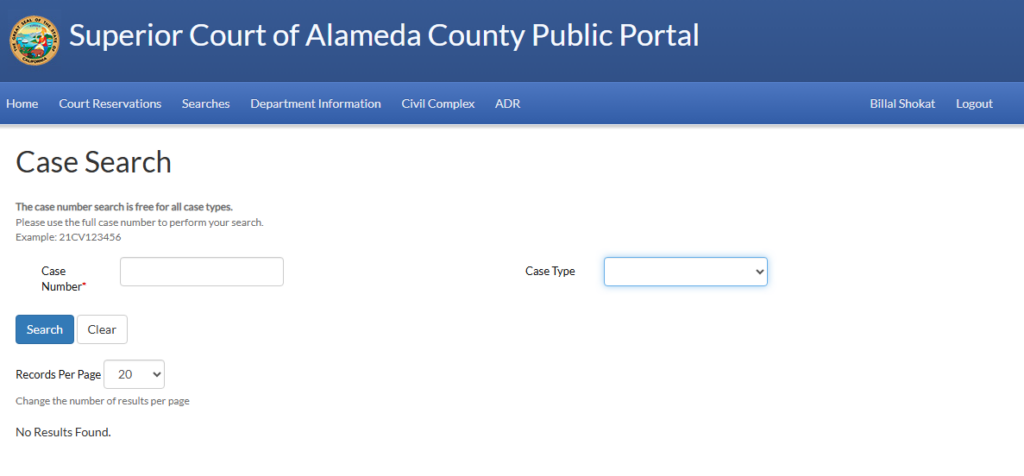
Instructions to Use the Alameda County Court Case Search URL
An interactive Alameda County Court Case Search Tool should appear directly below this section to match user intent and reduce friction. The instructions below explain how users interact with that tool from start to finish.
Open the Official Case Search Page
The user opens the official portal using the URL listed above. The homepage displays several search options related to court records.
Select the Case Search Option
The user chooses the case search feature. This option leads to a search form designed for public court records.
Choose a Search Method
The tool provides two primary search methods:
- Name-based case search for party names
- Case number search for direct lookup
Enter Search Details
For a name search, the user enters:
- First name
- Last name
For a case number search, the user enters:
- Full case number or partial number
Entering fewer details often returns broader results, which helps when exact information is unknown.
Select Case Type (Optional)
The tool allows filtering by case category, such as:
- Civil
- Criminal
- Family law
- Probate
- Traffic
Submit the Search
After entering details, the user submits the search request. The system scans public court records stored in the Alameda County Superior Court database.
Types of Cases Handled by Alameda County Superior Court
Alameda County Superior Court cases cover criminal, civil, family, probate, and traffic matters. Each case type follows its own rules, timelines, and hearing process within the county court system. The court handles both serious legal disputes and routine filings, giving residents a central place for trial court matters across Alameda County.
Criminal Cases
Alameda County Superior Court cases include a wide range of criminal court cases filed by state or local prosecutors. These cases focus on alleged violations of California law and may involve custody hearings, motions, trials, and sentencing.
Criminal filings often fall into two categories:
- Misdemeanor cases, such as minor theft or simple assault
- Felony cases, such as robbery, serious assault, or homicide
Civil Cases
Civil litigation involves legal disputes between private parties, businesses, or public entities. These matters seek money damages, court orders, or resolution of legal rights rather than jail time.
Common civil case types include:
- Contract disputes
- Personal injury claims
- Property and real estate disputes
- Employment-related filings
Family Law & Juvenile Matters
The family law court handles sensitive legal matters related to family relationships and child welfare. These cases often require ongoing court supervision and multiple hearings.
Family law filings may include:
- Divorce and legal separation
- Child custody and visitation
- Child or spousal support
- Domestic violence restraining orders
Probate & Mental Health Cases
Probate court cases deal with estates, trusts, and legal authority over another person’s affairs. Many probate filings follow the death of a family member or a medical incapacity event.
Probate and mental health cases may involve:
- Estate administration
- Guardianship of minors
- Conservatorship of adults
- Mental health commitment proceedings
Traffic & Infractions
Traffic court handles vehicle-related violations and local ordinance infractions. These cases usually move faster than other court matters and may not require in-person appearances for every filing.
Traffic and infraction cases often include:
- Speeding tickets
- Red light violations
- Driving without a license
- Local code enforcement issues
Superior Court of California, County of Alameda
The Superior Court of California, Alameda serves as the main trial court for legal matters within Alameda County. It operates as part of a unified statewide court system established under California law. This court handles trials and hearings, unlike higher courts that focus on reviewing prior decisions.
Structure of the California Court System
The California judicial system follows a three-level structure that applies across the state. At the base level sit the state trial courts, known as Superior Courts. Every county in California has one Superior Court, which manages trial-level cases.
Above the trial courts are the Courts of Appeal. These courts review legal errors claimed in trial court decisions. At the highest level stands the California Supreme Court, which addresses selected appeals and major constitutional questions. This tiered structure creates consistency across California courts structure and supports uniform legal interpretation statewide.
Role of the Superior Court of California Alameda
The Superior Court of California Alameda functions as the trial court for Alameda County. It hears criminal prosecutions, civil disputes, family matters, probate filings, and traffic cases. Judges in this court evaluate evidence, rule on motions, oversee jury trials, and issue final judgments. This court also manages pretrial hearings, case scheduling, and enforcement of court orders. Since it operates within the statewide system, its procedures align with California Rules of Court and state statutes.
Trial Courts Compared to Appellate Courts
- Superior Courts and appellate courts serve different purposes. Superior Courts conduct trials, hear witness testimony, and evaluate facts. Appellate courts do not retry cases or hear new evidence. Their role centers on reviewing legal arguments raised after a trial court decision.
- A case usually begins in a Superior Court. Only after a final judgment may a party seek review from an appellate court. This distinction defines the role of state trial courts within California’s legal framework.
Constitutional Foundation of California Superior Courts
California’s Constitution establishes Superior Courts as courts of general jurisdiction. This means they hold authority over most legal disputes within their counties. Court unification reforms later combined former municipal and superior courts into a single trial court per county. This constitutional basis secures the authority of the Superior Court of California Alameda and confirms its central role in administering justice at the county level.
Jurisdiction and Authority of Alameda
Court jurisdiction defines the legal power a court holds over cases, people, and locations. As a trial court, Alameda County Superior Court has broad authority to hear most civil and criminal matters filed within the county.
Meaning of Jurisdiction in California Courts
In California courts, court jurisdiction refers to a court’s legal power to hear a case and issue binding decisions. This power covers three main areas: subject matter, people involved, and geographic location. Without proper jurisdiction, a court cannot proceed with a case. The Alameda County Superior Court holds original jurisdiction, which means cases usually start here rather than in higher courts. Judges hear evidence, review filings, rule on motions, and issue judgments at this level of the judicial system.
Types of Cases Within Court Jurisdiction
As a trial court, Alameda County Superior Court exercises both civil and criminal jurisdiction. This allows the court to oversee a wide range of legal matters filed within county boundaries.
Cases under its authority include:
- Criminal prosecutions for misdemeanors and felonies
- Civil disputes involving contracts, injuries, or property
- Family law matters such as divorce and child custody
- Probate cases related to estates and conservatorships
- Traffic and local ordinance violations
Monetary Limits and Judicial Authority
The court’s judicial authority includes the power to decide cases with varying monetary values. Civil cases often fall into different categories based on the amount in dispute.
Common examples include:
- Limited civil cases with lower dollar amounts
- Unlimited civil cases with higher claimed damages
Geographic Jurisdiction in Alameda County
Geographic jurisdiction limits the court’s reach to Alameda County. A case must involve events, property, or parties connected to the county for filing to be proper. Court locations across the county handle cases based on venue rules and case type. This structure supports fair case distribution and local judicial administration. This defined jurisdiction confirms Alameda County Superior Court’s role as the primary forum for trial-level legal matters within county borders.
Accessing Alameda County Court Records & Documents
Alameda County court records are open to the public in many situations, with limits set by California law. Records can be reviewed online, requested in person, or ordered as copies through approved court channels. Public access covers many filings and case details, yet sealed and confidential matters remain restricted.
Public Availability of Alameda County Court Records
Alameda County court records fall under California’s public records rules. Many filings qualify as public court records, meaning members of the public may review them without special permission. These records often include court dockets, civil case summaries, criminal case summaries, and traffic case information.
Public status applies to most adult criminal and civil matters. Family law and probate filings may show limited details. Juvenile cases and certain mental health proceedings remain restricted by statute. Court staff follow strict rules when releasing records to protect privacy and legal rights.
Requesting Court Records Online
Many users start with online court documents through the official Alameda County Superior Court portal. Online systems show case summaries, party names, filing dates, and hearing schedules.
Online access usually allows:
- Case number lookup
- Name-based searches
- Viewing docket activity
- Reviewing document titles
Requesting Copies in Person or by Mail
Certified and non-certified copies remain available through the clerk’s office. In-person requests take place at the courthouse handling the case. Mail requests require a written form with case details and payment.
Certified copies carry a court seal and serve official purposes such as legal filings or identity verification. Non-certified copies work for personal reference.
Common requirements include:
- Case number or party name
- Valid identification
- Copy type selection
Fees, Processing Times, and Limits
Copy fees vary based on document length and certification status. Certified copies usually cost more due to verification steps. Processing time ranges from same-day service to several business days, depending on request volume. High-demand records may require extended processing. Payment methods depend on request type and location.
Confidential and Sealed Court Records
- Some court records remain closed to the public. Sealed records require a court order for release. Confidential records include juvenile filings, adoption cases, and sensitive mental health matters.
- Clerks review each request before release. Requests for restricted records without legal authority result in denial. These safeguards protect personal data and court integrity.
Judges, Administration, and Court Governance
Alameda County Superior Court judges preside over trials, hearings, and legal proceedings across civil, criminal, family, and probate cases. They interpret the law, rule on motions, and ensure fair process within the court system. The court’s governance also relies on administrative officers who manage daily operations, case assignments, and court policy implementation.
Role of Judges in the Superior Cour
Judges, also called judicial officers, oversee trials and hearings in Alameda County. They evaluate evidence, manage courtroom proceedings, and issue judgments in accordance with California law. Judges may also handle pretrial motions, settlement conferences, and emergency requests in urgent matters. Their work ensures that cases progress efficiently and decisions comply with legal standards.
Appointment and Election of Judges
In California, Superior Court judges can be appointed or elected. Vacancies are filled by the Governor’s appointment, after which judges stand for retention elections during general elections. This combination ensures both executive oversight and public accountability. Judges serve set terms, after which they may seek reelection or retirement according to state rules.
Court Administration and Governance
The Alameda County Superior Court is organized under a structured court administration system. A presiding judge leads the court, supervising case management, budget allocation, and internal policy. Other administrative officers support operations, including clerk management, scheduling, and technology oversight. This framework allows the court to manage high case volumes, coordinate across departments, and maintain consistent judicial standards throughout the county.
Alameda County Superior Court vs Other California Courts
Alameda County Superior Court serves as a trial court handling initial filings, hearings, and trials for civil, criminal, family, probate, and traffic matters. Higher courts, including appellate courts and the California Supreme Court, review cases after a final judgment. The court is part of the broader California courts system, forming the base level of the California judicial hierarchy.
Superior Court vs Court of Appeal
The main difference between Superior Courts and appellate courts lies in function. Superior Courts handle original trials, examine evidence, and hear witnesses. In contrast, the Court of Appeal does not retry cases; it reviews trial court decisions for legal errors. Appeals from Alameda County Superior Court move to the First District Court of Appeal, which may affirm, reverse, or remand cases back to the trial court.
Superior Court vs California Supreme Court
The California Supreme Court represents the highest authority in the state. It reviews a limited number of cases, often involving constitutional questions, significant legal precedent, or conflicts among appellate courts. Unlike the Superior Court, the Supreme Court does not conduct trials or hear witness testimony. Only selected cases from Alameda County Superior Court that have passed through appellate review reach this level.
When Cases Move Beyond Alameda County Superior Court
Cases escalate beyond Alameda County Superior Court when one party challenges a judgment or ruling. The appellate process examines whether the trial court applied the law correctly. After appellate review, some cases may proceed to the California Supreme Court, though this is rare. This system ensures that the California courts hierarchy provides checks and legal consistency across all counties, including Alameda.
Filing, Fees, and Court Procedures
Alameda County court procedures explain how legal documents are filed, fees are paid, and deadlines are followed. The court accepts filings both electronically and in person. Following the rules helps cases proceed smoothly without delays. Understanding the process reduces mistakes and ensures timely processing of all submissions. Proper knowledge of filing methods, fee schedules, and compliance requirements is essential for anyone using the court system. This ensures filings are accepted and legal rights are protected.
Filing Court Documents
Filing documents with Alameda County Superior Court can be done electronically or in person. Electronic filing is widely available for many civil, family, and probate cases, while certain case types may still require physical submission. Accurate filing helps establish official records and ensures cases move efficiently through the court system. Users must follow specific formats and provide all required documents for successful submission.
Filing Methods:
- Electronic Filing (e-filing California):
- Submit documents online via the official court e-filing portal.
- Upload in PDF format and receive a confirmation receipt electronically.
- Tracks submissions automatically, reducing processing delays.
- In-Person Filing:
- Required for certain criminal filings, small claims, or other restricted case types.
- Clerk staff review documents, stamp them, and assign case numbers.
- All supporting documents and fees must accompany the filing.
Fee Schedules
Court fees vary depending on the type of case and the documents being filed. Civil cases, family law matters, and traffic violations have different fee requirements. Understanding the fee schedule ahead of time ensures proper payment and prevents delays or rejected filings. Some filers may qualify for fee waivers based on income eligibility.
Fee Details:
- Civil Cases: Base filing fee plus additional fees for motions or document copies.
- Family Law Cases: Fees for divorce, custody, or support filings.
- Traffic & Infractions: Fines or administrative fees may apply instead of traditional filing fees.
- Payment Methods: Cash, check, money order, or online payments through e-filing portals.
- Fee Waivers: Available for qualifying low-income filers with court approval.
Deadlines and Compliance Requirements
Meeting deadlines is critical for maintaining the integrity of a case in Alameda County courts. Each case type has specific rules for initial filings, responses, and motions. Courts provide online calendars and notifications to help track due dates. Proper formatting, signatures, and the correct number of copies are required to avoid delays or rejections.
Key Requirements:
- Specific Deadlines: Initial filings, responses, and motions must meet case-specific timelines.
- Consequences of Late Filing: Late submissions can result in rejection, fines, or missed hearings.
- Formatting & Copies: Documents must follow court standards for format, number of copies, and signatures.
Locations & Courthouses
Alameda County Superior Court locations are spread across the county to handle different types of cases efficiently. Major courthouses in Oakland, Hayward, Fremont, and other areas serve specific case categories while providing public access. Each courthouse maintains accessibility, parking, and visitor services to help residents manage filings, hearings, and other court-related matters without confusion.
Major Courthouses in Alameda County
Alameda County has several courthouses in Alameda County, each serving as a hub for particular case types. The main location in Oakland handles the majority of civil and criminal cases, while other courthouses specialize in family law, traffic, probate, or small claims. Knowing the correct courthouse ensures filings and hearings proceed without delays.
Key Locations:
- Oakland Courthouse:
- Primary location for civil litigation, criminal trials, and major jury cases.
- Address: 1225 Fallon Street, Oakland, CA 94612.
- Hayward Hall of Justice:
- Focuses on family law cases, juvenile matters, and some probate filings.
- Address: 24405 Amador Street, Hayward, CA 94544.
- Fremont Hall of Justice:
- Handles traffic, small claims, and limited civil cases.
- Address: 39439 Paseo Padre Parkway, Fremont, CA 94538.
- Newark Courthouse (Probate & Juvenile):
- Dedicated to probate filings, conservatorships, and certain juvenile cases.
- Address: 37014 Civic Center Drive, Newark, CA 94560.
Case Types by Location
Different courthouses specialize in particular case types to manage the judicial districts efficiently. Filing at the correct location ensures quicker processing and avoids rescheduling issues.
Case Type Assignments:
- Civil, criminal, and major jury cases: Oakland
- Family law and child custody matters: Hayward
- Traffic violations and small claims: Fremont
- Probate, guardianship, and juvenile cases: Newark
Accessibility, Parking, and Visiting Tips
Courthouses in Alameda County provide essential services for visitors, including accessible entrances, parking facilities, and public transport connections. Each courthouse follows safety and security protocols to manage visitors efficiently.
Visitor Tips:
- Plan extra time for security screenings and parking.
- Check online for courthouse hours and holiday closures.
- Use public transportation where available to avoid congestion.
- Refer to official websites for maps and specific courtroom locations.
Frequently Asked Questions
This section provides clear answers to common questions about the Alameda County Superior Court, including public access to records, case durations, and contact methods. The FAQ format helps residents quickly find practical information without navigating multiple pages.
Are court records public in Alameda County?
Yes, many court records are public under California law. This includes most civil and criminal filings, traffic cases, and some probate or family law records. Certain records, such as juvenile cases, sealed documents, or sensitive mental health filings, remain restricted. Public records can be viewed online or requested in person, following the court’s access rules.
How long do cases stay on record?
Case information typically remains on file indefinitely as part of the Alameda County Superior Court official records. Active case files are updated throughout proceedings, and even closed cases are retained for historical and legal purposes. Some records may have additional privacy restrictions or may be removed only through court orders or statutory provisions.
How can I contact the court?
There are several ways to contact the Alameda County Superior Court for information or assistance:
- Phone: Each courthouse has dedicated lines for civil, criminal, family, and traffic matters.
- Email or online portals: Many courthouses provide forms and inquiry options online for general questions or case-specific requests.
- In-person visits: Court clerks are available during business hours at each courthouse to assist with filings, documents, and procedural questions.
What types of cases does the court handle?
The Superior Court covers a broad range of cases, including civil litigation, criminal prosecutions, family law, probate, and traffic or infraction matters. Each case type follows specific procedures and may be assigned to different courthouse locations depending on jurisdiction and case volume.
Can I get copies of my court documents?
Yes, residents can request copies of documents from their case files. Certified copies are available for legal purposes, while non-certified copies are usually for personal reference. Requests can be made online, by mail, or in person at the relevant courthouse. Fees may apply, and certain sealed or confidential records require a court order for release.